.svg)

Why Surfing Loads The Body The Way It Does
Surfing looks like a lower-body sport from the beach. In practice, most of the session is spent prone on a board, paddling with the shoulders, extending the neck to watch the horizon, and holding the low back in a sustained arch. A two-hour session at Waikiki or a dawn patrol out at Ala Moana Bowls can involve thousands of paddle strokes and only a handful of rides. The ratio matters. The repetitive work is what shapes the body, not the standing.
That paddling posture puts three regions under continuous demand. The shoulders repeat a wide arc of motion under water resistance. The neck holds extension against gravity while the chest presses into the deck. The lumbar spine sits in prolonged extension with the abdominal wall unsupported. None of those positions is harmful on its own. Sustained across seasons of consistent surfing, they create predictable patterns that show up as stiffness, pinching, and eventually pain.
The Paddling Shoulder
Each stroke asks the shoulder to reach overhead, pull through, and recover, with the arm working from an unstable base because the trunk is floating rather than planted. The rotator cuff group stabilizes the humeral head through that entire arc. When those small muscles fatigue before the session ends, larger movers take over and the head of the humerus starts to sit slightly forward and high in the socket. That shift narrows the space where cuff tendons pass, and repeated passes through a narrowed space is how impingement patterns begin.
Surfers often describe it as a catch at a specific point in the stroke, or a dull ache at the outer shoulder that shows up hours after paddling in. Reaching behind the back to pull a wetsuit zipper or lift a board onto a roof rack becomes the moment they notice something changed.
The Extended Neck
Watching for sets means holding the head up while lying flat. That is sustained cervical extension with the suboccipital muscles at the base of the skull doing the work. Those muscles are dense with position sensors and connect closely to the systems that control balance and eye movement. When they stay short and irritable, the result can be a band of tightness at the skull base, headaches that begin at the neck and refer forward, and a sense that head turns feel gritty on the drive home.
Upper cervical mechanics matter here because the top two segments of the neck carry most rotation and a large share of the extension. Restriction at that level forces the segments below it to make up the difference, and the lower neck is not built for the extra range.
Wipeouts And Impact Load
Paddling injuries build slowly. Wipeout injuries arrive in a second. Going over the falls at a reef break, hitting sand at a shorebreak like Sandy Beach or Makapuu, or getting driven down by a set wave all deliver forces the spine has no time to brace against. The head snaps, the trunk twists, and the shoulder can be pulled into end range while the body is rotating the other way.
Most surfers surface, shake it off, and paddle back out. The tissue does not resolve that fast. A hard wipeout can strain the cervical ligaments and joint capsules the same way a low-speed rear-end collision does, and the pattern of symptoms is similar: fine that afternoon, stiff the next morning, and headachy by day three. When someone comes to Ke'Ale Chiropractic reporting neck pain that started a week after a session, the wipeout is often the event they forgot to mention.
What To Watch For After A Hard Hold-Down
Some symptoms warrant evaluation rather than waiting. Persistent neck stiffness beyond a few days, headaches that were not there before, numbness or tingling down an arm, dizziness with quick head turns, or any loss of strength in the hand deserves a proper exam. Reef cuts get attention because they are visible. Joint and ligament strain from the same wave usually does not.
The Low Back Under An Arch
Prone paddling holds the low back in extension for the length of the session. The facet joints at the back of the lumbar spine compress in that position, and the deep stabilizers along the spine work isometrically the whole time. Add the explosive pop-up, which asks for a fast transition from extension into flexion and rotation under load, and the low back becomes the region surfers most often name when asked what bothers them. A tight front hip makes it worse, because a hip that will not extend forces the lumbar spine to borrow the range.
How Ke'Ale Chiropractic Evaluates A Surfer
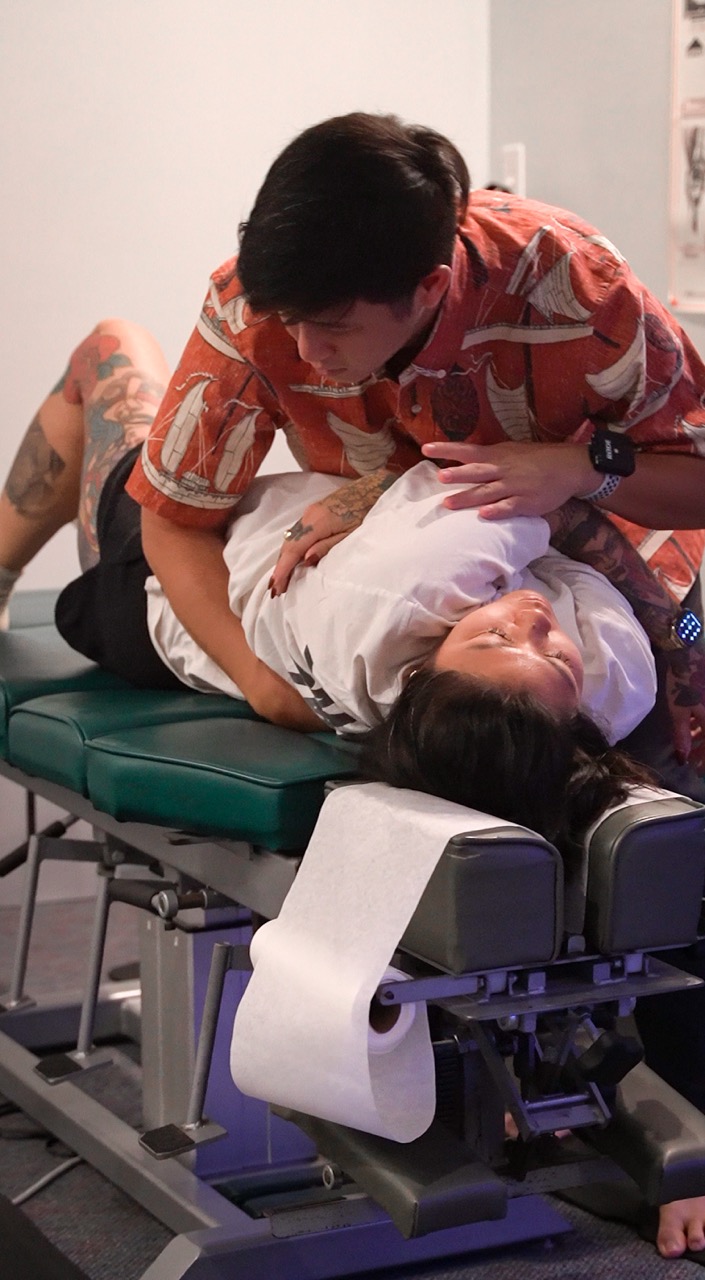
An exam for a surfer is not the same as an exam for a desk worker with the same complaint. Dr. Wyland Luke and Dr. Bryan Luke look at the whole chain that produces the paddle stroke and the pop-up, because shoulder pain in a surfer often traces back to the mid-back or the neck rather than to the shoulder itself.
Because surfing is one of the few sports that combines endurance paddling, impact exposure, and explosive transitions in the same session, the exam has to account for all three. The assessment typically covers cervical range and segmental motion with particular attention to the upper cervical spine, thoracic extension and rotation, scapular control through a paddling arc, rotator cuff strength tested at several angles, lumbar extension tolerance, and hip extension and internal rotation. Session frequency, board type, wave conditions, and how someone carries their board all get discussed, because those details explain why one side is loaded more than the other.
Care That Fits A Surf Schedule
Treatment usually combines gentle adjustment or mobilization of restricted spinal segments, soft tissue work through the suboccipitals, pecs, lats, and the tissue around the scapula, and progressive loading for the muscles that failed to hold position. Upper cervical work matters for surfers with headaches and balance complaints, since the sensors in that region feed head and eye control directly.
The exercise side is deliberately short. Surfers do not want a gym program, so the useful version is a handful of movements that can be done before paddling out and after coming in. Thoracic extension over a rolled towel. Scapular setting drills. External rotation work with a band. Chin tucks to counter session extension. Hip flexor length work to give the low back its range back.
Loading Rather Than Resting
Complete rest rarely serves a surfer well. Tendon tissue responds better to graded load than to time off, and stopping entirely means losing the conditioning that protected the shoulder in the first place. The more effective approach is modifying the session while the tissue adapts: shorter paddles, easier conditions, fewer sessions in a week rather than zero, and a board with more volume so paddling costs less effort.
Building Durability For Year-Round Surf
Oahu offers waves in every season, which is a gift and a problem. Somewhere on the island is working almost every day, so there is little natural offseason to force recovery. Surfers here tend to accumulate volume without ever backing off.
Two habits make the biggest difference. The first is a real warm-up before paddling out, even five minutes of arm circles, thoracic rotations, and hip openers on the sand. Cold tissue paddling straight into a set is where a lot of shoulder strains begin. The second is off-water training that supports the specific demands of surfing: pulling strength for the paddle, rotational control for the turn, hip and glute strength for the pop-up, and endurance work for the deep neck flexors that oppose all that extension.
Sleep position also matters more than people expect. Surfers who sleep on the shoulder they paddle with often wake stiffer than they went to bed. Switching sides, or supporting the top arm with a pillow, is a free change that frequently reduces morning symptoms.
When Symptoms Should Not Be Waited Out
Pain that wakes you at night, weakness rather than soreness, shoulder pain that does not settle over three or four weeks of modified activity, numbness in the hand, or any neck symptom that appeared after a hard hold-down should be evaluated. Early assessment usually means simpler care. Waiting until a shoulder cannot get through a warm-up means a longer road back.
Get Back In The Water
Ke'Ale Chiropractic in Honolulu works with surfers who want to keep surfing, not sit out a season. If paddling strain, a lingering wipeout, or shoulder and low back pain is cutting your sessions short, schedule a visit with Dr. Wyland Luke and get a clear picture of what is actually driving it.


