.svg)

Oahu Trails Are Harder On Joints Than They Look
The hiking on this island is unusually steep for its elevation. Koko Head Crater Trail climbs roughly a thousand feet on an old railway incline made of railroad ties, which means it is stairs, not trail. Diamond Head packs a short but relentless climb with switchbacks and tunnels into a compact loop. Manoa Falls stays mostly gentle but adds slick roots and mud that force constant small corrections. The Makapuu Lighthouse trail is paved and exposed, trading technical difficulty for sustained grade in the heat.
None of these are long by mainland standards. That is precisely why they cause trouble. Hikers underestimate them, go out cold, move fast, and take the descent at speed because it feels easy. The joints disagree.
Descent Is The Part That Hurts
Going up is a cardiovascular problem. Coming down is a mechanical one. On the descent, the quadriceps work eccentrically, lengthening under load with every step to control the drop of body weight. That contraction type generates the highest forces and causes the most muscle damage. Knee joint forces during downhill walking run substantially higher than on level ground, and the steeper the grade, the higher they climb.
On the Koko Head ties, that repeats for over a thousand steps in a row with no variation in step height or rhythm. It is the most consistent eccentric loading most people ever ask their legs to do. Hikers who feel fine at the top and wrecked at the bottom are experiencing exactly what the mechanics predict.
Why The Knee Gets Blamed
The knee is a hinge caught between two joints that rotate. The hip above it and the ankle below it both control the plane the knee tracks in. When the hip cannot stabilize the femur, the thigh drifts inward on each step, the knee follows, and load concentrates on the outside of the kneecap and along the outer thigh. The knee hurts, but the knee did not cause it.
That is why treating hikers with knee pain by focusing only on the knee tends to produce short-lived results. The more useful question is what the hip and pelvis are doing while the knee is under load.
The Hip And Pelvis Do The Real Work
Every step on uneven ground is a single-leg balance task. The gluteus medius on the standing side keeps the pelvis level while the other foot swings. If that muscle is weak or slow to fire, the pelvis drops on the swing side, the standing hip drifts inward, and the whole chain below it goes off axis. On flat pavement the system absorbs it. On a steep, uneven descent, repeated hundreds of times, it does not.
The pelvis also has to accept rotational load. Walking is rotation: one hip flexes while the other extends, the pelvis rotates around the spine, and the trunk counter-rotates. When one sacroiliac joint moves poorly, or when the pelvis sits rotated because of a habit like always carrying a bag on the same shoulder, the trail exposes it. Hikers with one-sided hip or low back pain that only shows up on long descents are usually describing a pelvic mechanics problem, not a muscle strain.
Common Patterns Seen In Hikers
A few presentations come up repeatedly at Ke'Ale Chiropractic among people who hike Oahu regularly.
- Pain at the outer knee that builds during descent and eases with rest, often connected to hip stability rather than the knee itself
- Deep front-of-hip pinching at the top of a step-up, common on Koko Head and often tied to limited hip flexion and a stiff joint capsule
- One-sided low back and buttock ache after long hikes, frequently involving sacroiliac movement and pelvic control
- Achilles and calf tightness from sustained uphill grade, which then limits ankle motion and pushes more load to the knee
- Foot and arch fatigue from worn shoes or from hiking steep terrain in trail runners with no support left in them
Heat Adds To It
Trailheads at Koko Head and Makapuu offer almost no shade, and midday temperatures plus humidity accelerate fatigue. Fatigued muscles stabilize worse. Most people are not injured by the first half of a hike, they are injured by the last twenty minutes of it, when control has degraded and they are hurrying to finish. Going early is a genuine injury prevention strategy, not just a comfort preference.
How Ke'Ale Chiropractic Evaluates A Hiker
Dr. Wyland Luke and Dr. Bryan Luke look at the whole chain from the foot to the spine, because hikers rarely have a problem confined to one joint. The exam typically includes hip range of motion compared side to side, single-leg stance quality, step-down control watched from the front, pelvic and sacroiliac motion, ankle dorsiflexion, lumbar segmental movement, and a look at how someone stands and shifts weight at rest.
Footwear comes into the conversation, along with trail choice, weekly volume, pack weight, and whether pain shows up going up, coming down, or the following morning. Timing is diagnostic. Pain during the climb points one direction, pain on descent another, and next-day soreness that fades is usually normal adaptation rather than injury.
Care And Loading
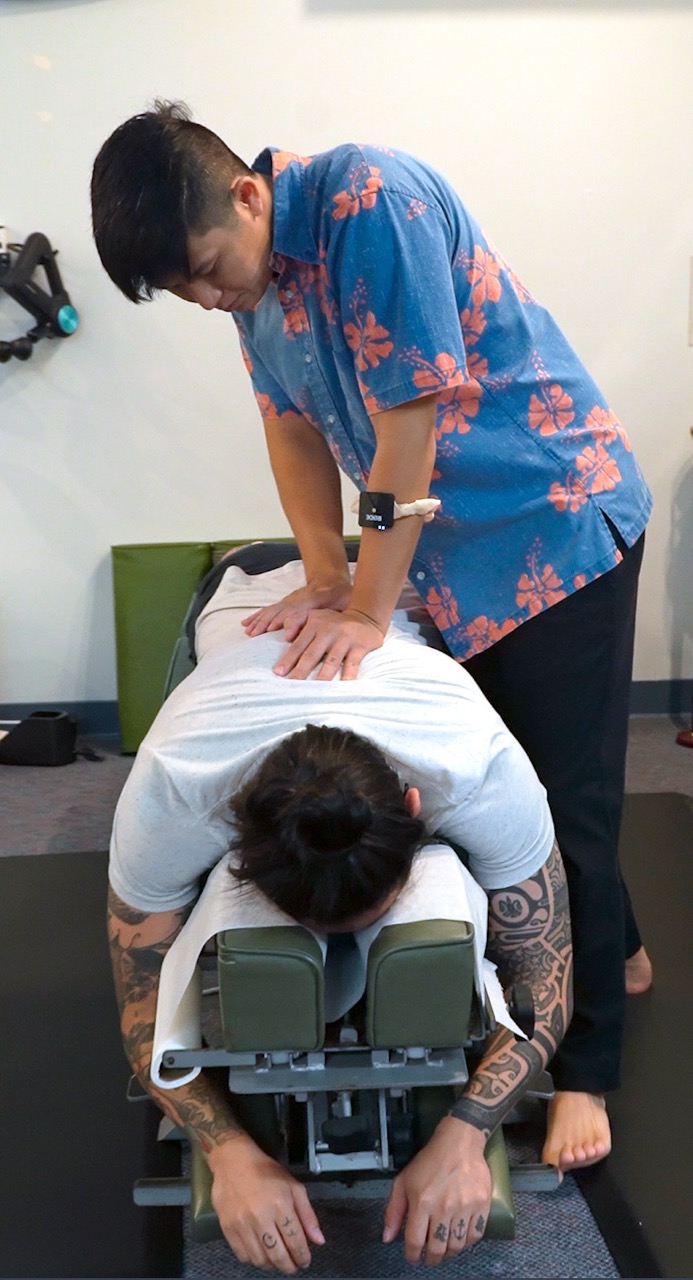
Treatment generally combines adjustment or mobilization of restricted segments in the pelvis, lumbar spine, and hips, soft tissue work through the glutes, hip flexors, and lateral thigh, and a loading program that rebuilds control where it failed. Because the demand is single-leg and eccentric, the exercises need to match that. Step-downs performed slowly, split squats, side-lying and standing hip abduction work, and calf loading for ankle tolerance do more for hikers than general leg strengthening.
Upper cervical care can matter for hikers too, particularly those who get headaches or feel unsteady on technical footing. Balance draws on input from the inner ear, the eyes, and position sensors in the upper neck. When neck mechanics are off, footing on uneven ground can feel less certain than it should.
Building A Body That Handles Descent
The single most effective preparation for steep Oahu hiking is training the descent specifically. Most people train the climb by climbing and hope the way down takes care of itself. Adding slow, controlled step-downs two or three times a week for a few weeks before a big hike changes how the legs handle a thousand ties in a row.
Poles help more than their reputation suggests, particularly on descent, where they measurably reduce load through the knees. Pacing helps as well. Descending under control costs time and saves joints. So does replacing shoes before the outsole and midsole are finished, since worn footwear removes traction and shock absorption at the same time.
Like most endurance sports, hiking rewards consistency over intensity. Three moderate hikes a week build more durability than one punishing weekend outing followed by six days off.
When To Get Checked
Knee or hip pain that persists more than two or three weeks after a hike, pain that appears on flat ground or on stairs at home, swelling, giving way, night pain, or numbness down the leg all warrant an exam. So does a hike that has quietly gotten shorter because something hurts. People adapt around pain long before they mention it, and the compensations are usually the thing that eventually forces the visit.
Get Back On The Trail
Ke'Ale Chiropractic in Honolulu works with hikers who want to keep climbing without paying for it the next day. If Koko Head, Diamond Head, or a long descent is leaving your hips and knees sore, schedule a visit with Dr. Wyland Luke and get the chain working the way it should.


