.svg)

Paddling Is An Asymmetric Sport
Outrigger canoe paddling runs deep on Oahu. Clubs launch out of Keehi Lagoon, Kailua, Hawaii Kai, and Waikiki, regatta season fills summer weekends, and the long distance races draw crews who train through the year. Paddlers range from keiki programs to masters crews still racing in their sixties. What they share is a movement pattern that repeats thousands of times per practice on one side of the body at a time.
That is the defining feature. Unlike sports that load both sides evenly, such as swimming or running, outrigger paddling is asymmetric by design. A paddler works one side until the call to change, then switches. Even with disciplined switching, most paddlers have a dominant side, a preferred seat, and a stroke that is more efficient in one direction than the other. Over a season, the tissue adapts to that imbalance, and the adaptation is not always the kind you want.
What The Stroke Actually Asks For
A clean stroke is a full-body chain. The reach comes from trunk rotation and shoulder flexion, not from the arm alone. The catch loads the lat and the muscles around the shoulder blade. The power phase drives through the legs and rotates the torso, transferring force through the core into the blade. The exit and recovery ask the shoulder to unload and reset quickly, often under fatigue.
When the chain works, the load spreads across the hips, trunk, and shoulders. When one link stops contributing, usually because it is stiff or weak, the load concentrates somewhere it was not meant to. That is the mechanism behind most paddling injuries seen at Ke'Ale Chiropractic, and it explains why the painful spot is rarely the actual problem.
Seat Position And Its Demands
Seat one sets the rate and takes the most water in the face. Seats two through five drive power and spend the most time in sustained rotation. Seat six steers, which means holding a static braced position with a twisted trunk for long stretches, often with the paddle wedged against the hull. Steersmen frequently present with one-sided low back and hip complaints that come from that sustained brace rather than from the stroke itself.
The Shoulder Under Repeated Load
The most common paddling complaint is shoulder pain, and the rotator cuff is usually involved. Those four muscles keep the head of the humerus centered in a shallow socket through every phase of the stroke. Under a high stroke rate over a long distance run, they fatigue before the big movers do. Once they fatigue, the shoulder loses its centering, the tendons pass through a narrower space, and irritation follows.
Paddlers describe it as a pinch at the catch, an ache along the outside of the upper arm, or trouble sleeping on that side. Reaching across the body to grab something, or lifting a canoe at the end of practice, becomes the movement that reveals it.
The contributing factors are usually upstream. A stiff thoracic spine means less rotation available, so the shoulder reaches further to make up the distance. Weak scapular control means the shoulder blade does not rotate properly to keep the socket under the arm. Tight lats and pecs pull the shoulder forward at rest. Address those and the cuff often calms down without ever being treated directly.
The Low Back And Rotation
The other frequent complaint is the low back. Lumbar segments are built for flexion and extension, not for much rotation. Most trunk rotation should come from the thoracic spine and the hips. When those regions are restricted, the lumbar spine absorbs rotation it is poorly designed to handle, hundreds of times per practice.
Add the seated position, which limits hip contribution and puts the pelvis into a posterior tilt, and the low back is working from a disadvantaged posture the entire time. Paddlers often notice the pain most when they stand up after a long run, or the morning after a hard distance session.
Neck And Upper Back
Sitting in the canoe means holding the head up and forward while the arms work in front of the body. That is the same load pattern as a long day at a desk, delivered at higher intensity. Suboccipital tightness at the base of the skull, mid-back stiffness between the shoulder blades, and headaches after long sessions all trace back to it. For paddlers who also work at a screen, the workday and the water session reinforce the same pattern rather than balancing it.
How Ke'Ale Chiropractic Approaches A Paddler
Dr. Wyland Luke and Dr. Bryan Luke examine paddlers with the asymmetry in mind. Comparing left to right is the starting point, because the meaningful finding is usually the difference between sides rather than an absolute value.
A typical assessment looks at thoracic rotation measured both directions, hip internal and external rotation, lumbar movement quality under rotation, scapular positioning and control through a paddling arc, rotator cuff strength tested at multiple angles, and upper cervical segmental motion. Training details matter too: which side is dominant, which seat, how often the crew changes sides, weekly water volume, and whether the paddler also does a repetitive job or sport on land.
Treatment And Progressive Loading
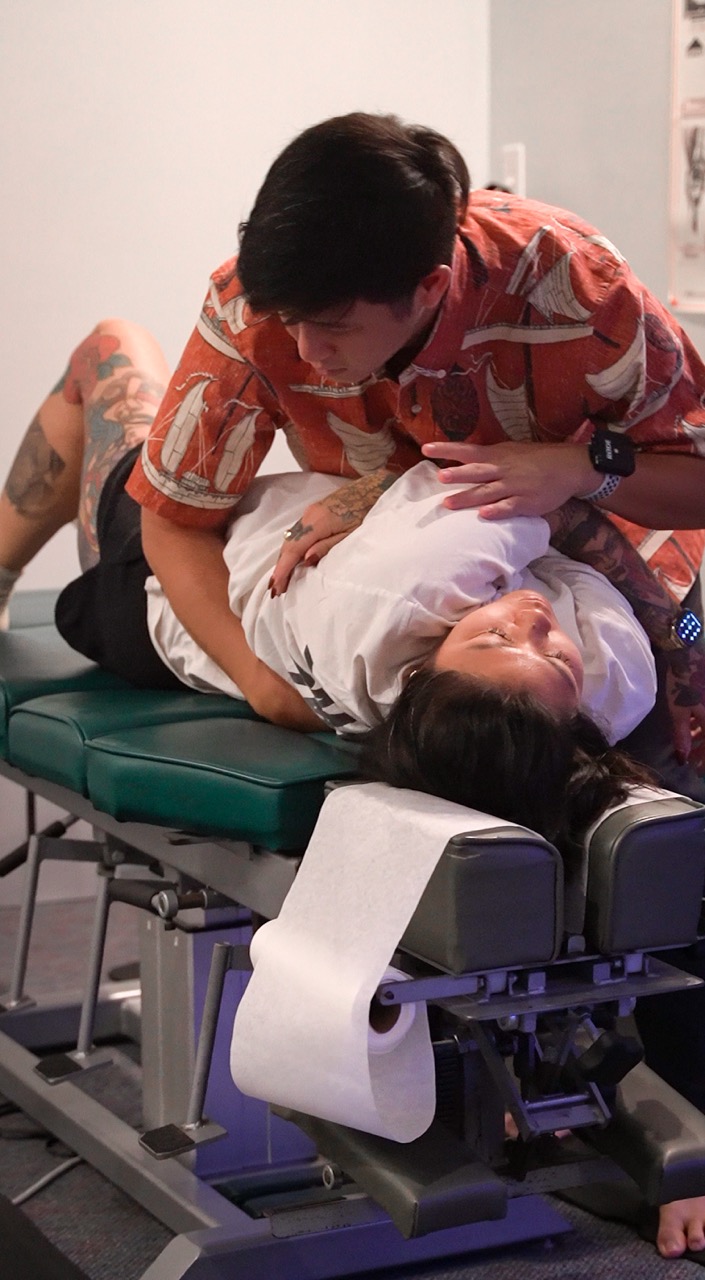
Care usually combines adjustment or mobilization of restricted segments in the thoracic spine, upper cervical spine, and pelvis, soft tissue work through the lats, pecs, and the tissue surrounding the scapula, and a loading program for the structures that gave out under fatigue.
The exercise side is built around three goals. Restore rotation where it belongs, in the thoracic spine and hips. Build endurance in the scapular stabilizers and cuff so they last a full session rather than the first twenty minutes. Train anti-rotation strength in the trunk so the low back is not the thing resisting the load. Half of that work can be done on the beach before practice.
Training Through Rather Than Stopping
Most paddlers do not want to be told to stop, especially mid-season with a regatta on the calendar. In most cases they do not have to. Tendon tissue adapts to graded load better than to complete rest, and detraining creates its own problems. The practical version is reducing volume rather than eliminating it, favoring the less loaded side during recovery weeks, dropping stroke rate before dropping distance, and building the corrective work into an existing warm-up so it actually happens.
Season Planning And Prevention
Regatta season and distance season load the body differently. Sprint racing means high rate and high force over short bursts. Distance means sustained moderate load over hours, which is where fatigue-driven technique breakdown does its damage. Paddlers who train year-round without a genuine lighter block tend to arrive at the end of the season carrying accumulated strain rather than fitness.
A few habits reduce risk without adding much time. Warm up on land before the first stroke, not during the first ten minutes of the paddle. Deliberately balance sides during easier training paddles, even if it feels less efficient. Do the lift and carry of the canoe with technique rather than urgency, since a meaningful share of paddling injuries happen on the beach rather than on the water. Keep a short strength routine going through the season instead of only in the preseason.
When To Get Evaluated
Shoulder pain that has not improved over three or four weeks of reduced volume, pain that wakes you at night, weakness rather than fatigue, numbness or tingling in the arm or hand, and low back pain that refers down the leg all warrant an exam. So does a stroke that has quietly changed because a movement hurts. Compensations become habits, and habits become the next injury.
Get Back On The Water
Ke'Ale Chiropractic in Honolulu works with paddlers who want to finish the season strong. If shoulder, back, or neck pain is showing up in your stroke, schedule a visit with Dr. Wyland Luke and find out what part of the chain stopped carrying its share.


