.svg)

Sciatica Is A Symptom, Not A Diagnosis
People use the word sciatica to mean leg pain that comes from the spine. That is close enough for conversation and not precise enough for treatment. Sciatica describes irritation of the sciatic nerve or the nerve roots that feed it, producing pain, numbness, tingling, or weakness along the path that nerve travels. The word tells you where the symptom is. It does not tell you why.
That distinction matters because the causes are different and they respond to different care. Effective treatment starts with identifying which structure is irritating the nerve, not with treating the leg where the pain is felt.
At Ke'Ale Chiropractic in Honolulu, Dr. Wyland Luke and Dr. Bryan Luke evaluate leg pain by tracing it back to its origin, examining the lumbar spine, the pelvis, and the hip as a connected system.
The Pathway
The sciatic nerve is the largest nerve in the body, roughly the diameter of a thumb where it forms. It is assembled from nerve roots exiting the spine at the fourth and fifth lumbar levels and the first three sacral levels. Those roots merge in front of the sacrum, pass through the pelvis, exit beneath or occasionally through the piriformis muscle deep in the buttock, and run down the back of the thigh. Behind the knee it divides into two branches that continue into the lower leg and foot.
Anywhere along that route, pressure or chemical irritation can generate symptoms felt further down. This is why the pain is so often described as running rather than sitting still. Patients trace it with a hand: from the low back, across the hip, down the back of the thigh, sometimes past the knee into the calf, occasionally into the foot and toes.
What Different Levels Feel Like
The pattern gives clues about the level involved. Irritation at the fifth lumbar root tends to send symptoms down the outside of the leg into the top of the foot and the big toe, sometimes with weakness lifting the foot. First sacral root involvement typically travels down the back of the calf into the heel and the outer foot, and may weaken push off when rising onto the toes. Pain that stops at the buttock or upper thigh without traveling below the knee is more often a joint or muscular referral than true nerve root compression.
Common Causes
Disc Related Compression
A lumbar disc bulge or herniation is the most frequent cause in adults under fifty. The disc material presses on the nerve root and, just as importantly, produces inflammatory chemistry that irritates it. This is why leg pain can persist even when the mechanical pressure is modest. Disc related sciatica usually worsens with sitting, bending forward, coughing, and sneezing, and often eases with standing or walking.
Stenosis And Facet Changes
In older adults, narrowing of the space where nerves exit is more common. Arthritic change at the facet joints, thickened ligaments, and disc height loss all reduce the available room. Stenosis related symptoms often reverse the disc pattern. Standing and walking bring the pain on, and sitting or leaning forward over a shopping cart relieves it, because forward flexion opens the space.
Piriformis And Deep Gluteal Involvement
The piriformis crosses directly over the sciatic nerve in most people. When it is chronically tight or in spasm, it can compress or tether the nerve without any spinal pathology at all. This presentation tends to produce deep buttock pain that worsens with prolonged sitting, driving, or sitting on a wallet, and it often reproduces when the hip is stretched into internal rotation.
Sacroiliac And Hip Contributors
The sacroiliac joint refers pain into the buttock and back of the thigh in a pattern patients frequently call sciatica. Hip joint problems can do the same, though hip pain more typically presents in the groin and outer thigh. Distinguishing these from true nerve involvement is a core part of the examination, because the treatment diverges sharply.
Why Sitting Makes It Worse
Sitting raises pressure inside the lumbar discs above what standing produces. Slouched sitting raises it further, because the pelvis rolls back and the low back loses its natural curve. Add the deep gluteal muscles compressed against a seat and a nerve that dislikes sustained tension, and you have the conditions that turn a manageable ache into a day ruining one.
Honolulu makes this specific. The commute along the H-1 between the leeward side and town is not short, and traffic turns it longer. A car seat holds the hips lower than the knees in many vehicles, which encourages exactly the posture the low back tolerates least. Office workers downtown, rideshare and delivery drivers, and anyone whose day includes long stretches in a seat all accumulate the same load. Desk work follows the drive, and the tissues never get a chance to unload.
Practical Adjustments For Drivers And Desk Workers
- Raise the seat or add a wedge cushion so hips sit level with or slightly above knees
- Place a small rolled towel or lumbar support at the belt line to preserve the low back curve
- Move the seat close enough that you are not reaching for the pedals with an extended leg
- Take the wallet out of your back pocket
- Stand and walk for two minutes every thirty to forty five minutes at a desk
- Break long drives where you can, even for a short stop
- Alternate sitting and standing if your workstation allows it
Conservative Care First
The evidence supports starting with conservative management for most sciatica. The majority of cases improve substantially over weeks to a few months without surgery, and early aggressive intervention does not reliably produce better long term outcomes than a well run conservative course.
What Evaluation Involves
A proper exam distinguishes nerve root involvement from referred pain. That means neurological testing of reflexes, muscle strength, and sensation in the specific distributions each root supplies. It means neural tension testing to see whether stretching the nerve reproduces the symptoms. It means assessing which movements provoke and which relieve, because a directional preference is one of the most useful findings available and it shapes the home program. It also means examining the hip, sacroiliac joint, and gluteal muscles rather than assuming the spine is at fault.
Imaging is not needed for most cases at the outset. Disc findings on scans are common in people without any symptoms, so an image alone rarely settles the question. Imaging becomes appropriate when there is progressive neurological loss, when symptoms fail to respond to a reasonable course of care, or when serious pathology is suspected.
What Care Looks Like
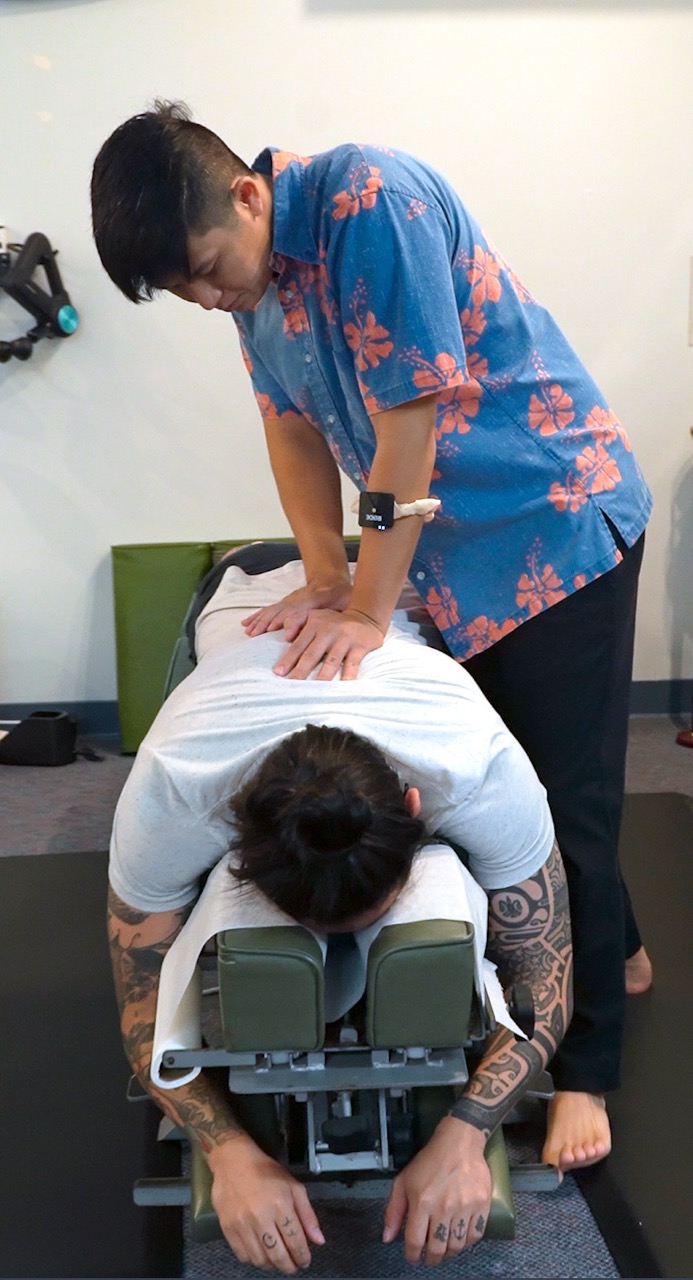
Treatment usually combines spinal manipulation or mobilization to restore segmental motion, soft tissue work through the gluteal group and piriformis, nerve gliding techniques to reduce mechanical sensitivity along the pathway, and a progressive home program. The home program matters more than most patients expect. Directional preference exercises, core and gluteal strengthening, hip mobility work, and sitting modification are what keep the improvement once care tapers.
Ke'Ale Chiropractic's upper cervical focus does not mean the rest of the spine goes unexamined. Whole spine mechanics influence how the low back loads, and evaluation covers the region generating the symptoms.
Signs That Need Immediate Medical Attention
Some findings are urgent and belong in an emergency department, not a chiropractic office. Loss of bladder or bowel control, numbness in the saddle region between the legs, or rapidly progressing weakness in both legs can indicate cauda equina syndrome, which is a surgical emergency. Severe unexplained weight loss, fever with back pain, or a history of cancer with new back pain also warrant prompt medical evaluation.
Realistic Expectations
Most patients notice the pain retreating up the leg before it lessens overall. Symptoms that used to reach the foot pull back to the calf, then the thigh, then the buttock. That centralization is a good sign even when the intensity has not dropped much yet. Flare ups during recovery are normal and usually follow a specific provocation, such as a long drive or a heavy lift. What matters is the trend across weeks, not the reading on any single day.
Schedule An Evaluation In Honolulu
Leg pain that has outlasted a couple of weeks, symptoms that reach past the knee, or a back that keeps flaring after every long commute all deserve a proper examination rather than another round of waiting it out. Ke'Ale Chiropractic in Honolulu offers thorough assessment and conservative care with Dr. Wyland Luke and Dr. Bryan Luke. Book a visit and find out what is actually irritating the nerve.


