.svg)

Two Different Desks, One Posture
Honolulu's knowledge work happens in two places now. There are the towers Downtown and along Bishop Street, where the desk is standard issue, the monitor sits at whatever height IT left it, and the chair adjusts if you know which lever to pull. And there are the several thousand people working from a Kaimuki apartment, a Kakaako condo, or a Manoa spare room, where the desk is often a dining table and the monitor is a laptop screen sitting flat.
The postures converge. In both settings the head drifts forward of the shoulders, the upper back rounds, the shoulders roll in, and the chin pushes slightly up to keep the eyes level. Hold that for a workday, five days a week, and you get tech neck: not a disease but a load pattern, and one that produces a very consistent set of complaints.
Why the Home Setup Is Usually Worse
A laptop is an ergonomic compromise by design. The screen and the keyboard are fixed to each other, so you can put the screen at the right height or the keyboard at the right height, never both. On a kitchen table the screen ends up around chest level, which means the neck flexes forward all day. On a couch, it is worse.
Office setups fail differently. The monitor is often too low because it sits on the desk rather than a riser. The chair is set for a previous occupant. The mouse lives too far out to the side, which drags one shoulder forward and loads that side of the neck. Dual monitors placed side by side push the head into a sustained rotation toward whichever screen holds the primary work.
What Forward Head Posture Actually Costs
The head weighs roughly ten to twelve pounds when it sits balanced over the shoulders. Tip it forward and the leverage against the neck rises sharply. At thirty degrees of flexion the effective load is several times the resting weight. The cervical discs, facet joints, and posterior ligaments were not designed to hold that for eight hours a day.
The muscles change too. The deep neck flexors, which should quietly stabilize the front of the neck, lose endurance from disuse. The upper trapezius and levator scapulae take over the job of holding the head up and become chronically tight. The suboccipital muscles at the base of the skull shorten as the chin tips up to level the gaze. That combination produces the classic presentation: a band of tension at the skull base, aching between the shoulder blades, and a headache that shows up in the afternoon and worsens as the week goes on.
The Headache Connection
A cervicogenic headache starts in the neck and refers into the head. It typically begins at the base of the skull on one side, travels up and over toward the temple or behind the eye, and gets worse with sustained neck postures or after long screen sessions. It often improves briefly when you stand up and move.
That pattern is distinct from migraine, though the two can overlap and can also coexist. Where migraine tends to bring nausea, light and sound sensitivity, and sometimes visual aura, cervicogenic headache tracks with neck position and neck examination findings. Restricted motion at the upper cervical segments, tenderness in the suboccipitals, and reproduction of the headache on palpation are the exam findings that point that direction.
Any new severe headache, a headache with neurologic symptoms, or a sudden change in an established headache pattern needs medical evaluation. Ke'Ale Chiropractic refers when the presentation calls for it.
Ergonomics That Survive Contact With Reality
Elaborate setups get abandoned. Simple ones stick. The goal is a station that requires no effort to sit in correctly.
- Screen at eye level, arm's length away. The top third of the screen should be at or just below eye height. Books work as a riser. So does a ream of paper.
- Laptops need a stand and a separate keyboard and mouse. This is the single highest-value change for remote workers. Without it, no other adjustment fully solves the problem.
- Keyboard at elbow height, mouse close in. Elbows near the ribs, forearms roughly level, wrists straight. A mouse parked out to the side pulls the shoulder forward every time you reach for it.
- Chair close to the desk, feet flat. Sitting back from the desk forces a forward lean. Pull in. Support the low back. If the feet dangle, use a footrest or a box.
- Dual monitors angled inward. Put the primary screen directly in front of you and angle the secondary one in rather than leaving both flat.
- Standing desks need the same math. Match screen and keyboard heights in the standing position too, and alternate between sitting and standing rather than committing to either for the whole day.
Lighting and Glare Feed Neck Tension
Honolulu offices tend toward big windows and strong afternoon light. Glare on a screen makes people lean in and squint, which pulls the head forward. Position the monitor perpendicular to the window rather than facing it or backing it, and turn the screen brightness up to roughly match the room instead of fighting it.
Posture Resets That Take Thirty Seconds
Posture is not something you hold. It is something you return to. The most effective habit is frequent, brief correction rather than sustained effort.
Chin tuck. Sit tall, draw the chin straight back as if making a double chin, without tipping the head up or down. Hold five to ten seconds. Three or four reps. This reactivates the deep neck flexors and stacks the head back over the shoulders.
Scapular set. Draw the shoulder blades gently down and back. Not a military brace, just a quiet reset. Hold ten seconds.
Thoracic extension. Lace the hands behind the head, sit tall, and extend gently over the back of the chair. Breathe out at the top. Five reps.
Doorway chest opener. Forearm on the frame at shoulder height, step through slowly. Thirty seconds per side. The rounded shoulder pattern is half a chest problem.
Twenty-twenty-twenty. Every twenty minutes, look at something twenty feet away for twenty seconds. It rests the eyes and, done properly, it moves the head.
Strength Holds What Mobility Restores
Stretching a tight upper trapezius feels good and lasts about an hour. The reason it retightens is that something else is not doing its job. Two or three short sessions a week that train deep neck flexor endurance, lower trapezius and serratus control, and thoracic mobility will change how a workday feels within four to six weeks. Chin tuck holds lying down, prone Y raises, wall slides, and controlled band rows cover most of it.
How Ke'Ale Chiropractic Treats It
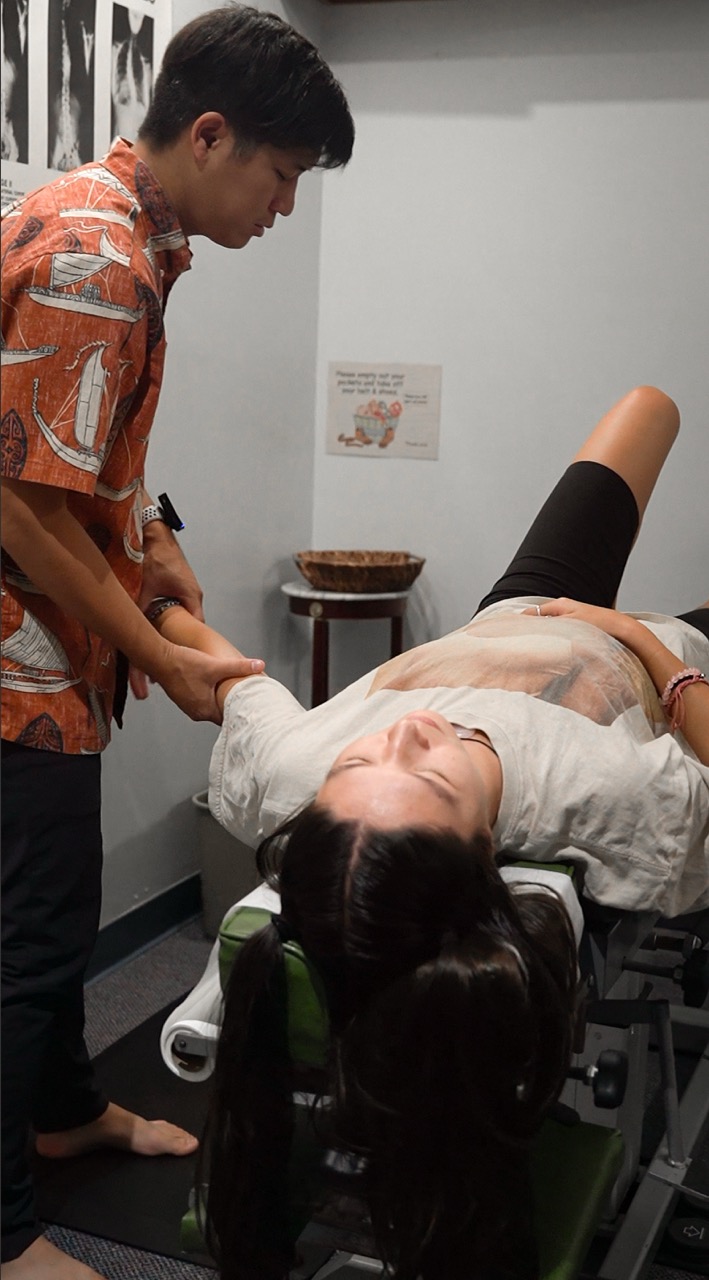
Dr. Wyland Luke and Dr. Bryan Luke evaluate the whole chain from the skull to the mid-back rather than treating the sore spot. The visit covers work setup, screen hours, headache pattern and timing, and an exam of cervical range of motion, segmental joint motion, deep neck flexor endurance, scapular control, thoracic mobility, suboccipital tenderness, and a neurologic screen when arm symptoms are present.
The clinic's upper cervical emphasis is particularly relevant here. The joints between the skull and the first two vertebrae carry a dense supply of position receptors and refer pain directly into the head. Restoring motion and position sense at those segments frequently addresses headaches that had been attributed to stress or screen time alone.
Care combines gentle, specific cervical and thoracic adjusting or mobilization, soft tissue work for the suboccipitals, upper trapezius, levator scapulae, and pectorals, and a graded home program. Desk coaching is part of the plan, not an afterthought, because the workstation is where the load is generated.
What Progress Looks Like
Within a few weeks most people notice head turns get easier and end-of-day headaches drop in frequency. By the second month, posture holds longer without conscious effort and long work blocks feel less punishing. By the third, full weeks pass with fewer flare-ups. Recheck the setup whenever you change jobs, offices, or move to a new desk, since the old pattern returns quickly on a bad station.
Book a Visit
If your neck, shoulders, or head are keeping score on your screen time, get it evaluated before the pattern hardens. Ke'Ale Chiropractic in Honolulu works with Downtown professionals and remote workers across Oahu on tech neck, ergonomics, and the headache that comes with them. Schedule with Dr. Wyland Luke or Dr. Bryan Luke and start a plan built around your actual desk.


