.svg)

Why Oahu Traffic Produces So Many Neck Injuries
Most people picture a car accident as a dramatic, high-speed event. The collisions that send drivers to a chiropractor in Honolulu rarely look like that. They happen at 10 or 15 miles per hour in the stop-and-go crawl on the H-1 heading into town, in the merge chaos where the H-2 feeds down toward Pearl City, in a Waikiki parking structure, or at a light on Ala Moana Boulevard when the driver behind you looks up half a second too late.
Low speed does not mean low force. In a rear-end impact, the seat pushes the torso forward before the head has begun to move. The neck absorbs that difference. It bends into an S-shape for a fraction of a second, with the lower cervical segments extending while the upper segments flex, then the whole chain snaps the other direction as the body decelerates. That sequence is what clinicians mean by whiplash. It is a mechanism of injury, not a single diagnosis, and it can strain ligaments, irritate facet joints, and overstretch the small muscles that hold the head steady.
The Damage Happens Faster Than You Can Brace
The entire event takes roughly a quarter of a second. Reflexes cannot fire that quickly. This is why drivers who saw the crash coming and drivers who never noticed it can end up with similar complaints. It is also why bumper damage is a poor predictor of how the neck feels a week later. Vehicles are engineered to absorb crash energy through crumple zones, and modern bumpers can shrug off an impact that still transmits significant force through the seat into the occupant.
Position at the moment of impact matters more than speed for many people. A head turned toward a passenger, an arm reaching for a phone in the cupholder, or a headrest set too low all change how the load distributes. Shorter drivers frequently sit with a headrest that functions as a neck rest, which offers little restraint to backward motion of the head.
Delayed Symptoms Are the Rule, Not the Exception
Adrenaline is a very effective short-term painkiller. In the minutes after a collision you are dealing with hazard lights, insurance cards, and traffic backing up behind you. Inflammation has not peaked yet, and injured tissue has not stiffened. Many people tell the responding officer they feel fine and mean it.
Symptoms typically build over the following 24 to 72 hours, and sometimes over a week or more. Common ones include:
- Neck stiffness that is worse in the morning or after sitting still
- Headache starting at the base of the skull and wrapping toward the temple or behind the eye
- Pain across the top of the shoulders and between the shoulder blades
- Reduced ability to turn the head, noticed first while checking a blind spot or backing out
- Jaw tightness or clicking
- Dizziness, unsteadiness, or a sense of visual lag with quick head turns
- Difficulty concentrating, unusual fatigue, or poor sleep
- Tingling, numbness, or weakness in an arm or hand
That last group deserves attention. Arm symptoms, worsening weakness, severe headache, vision changes, confusion, vomiting, or loss of consciousness at any point call for prompt medical evaluation rather than a wait-and-see approach. A chiropractic office is one part of a care team, not a substitute for emergency assessment when red flags are present.
The Head Takes a Hit Too
The neck and the head do not injure independently. The same acceleration that strains cervical tissue moves the brain inside the skull, which is why concussion-type symptoms and whiplash symptoms overlap so heavily. Headache, light sensitivity, brain fog, irritability, and disrupted sleep can come from either source or both. Any suspicion of a head injury should be evaluated promptly by a physician. If imaging or a medical assessment is warranted, Ke'Ale Chiropractic coordinates with your medical providers rather than working around them.
What to Do in the Days After a Crash
Keep this simple and practical. Document the crash while details are fresh: photograph both vehicles including the interior seat position, get the other driver's information, file the police report, and write down what you remember about the direction and force of impact and where your head was pointed. Insurers and providers both work from that record, and memory degrades fast.
Then see your providers promptly. A gap between the crash date and your first evaluation makes it harder to connect symptoms to the event, and more importantly, it lets protective muscle guarding settle in. Tissue that spends three weeks locked down heals shorter and stiffer than tissue that gets moving early. For questions about claims, liability, or benefits, talk to your insurer or an attorney. That is outside what any clinic should advise on.
Rest Is Not the Treatment
The old advice was a soft collar and a few weeks off. Current thinking runs the other direction. Prolonged immobilization tends to prolong recovery. Gentle, early, guided movement within tolerance generally produces better outcomes. That does not mean pushing through sharp pain or returning to heavy training in week one. It means keeping the neck moving through comfortable ranges, walking, and avoiding the instinct to hold the head perfectly still all day.
How Ke'Ale Chiropractic Evaluates Whiplash
Dr. Wyland Luke and Dr. Bryan Luke start with the crash itself. Direction of impact, seat and headrest position, head orientation, whether the collision was anticipated, airbag deployment, and what happened in the following hours all shape where to look. Two rear-end collisions at the same speed can produce very different injury patterns.
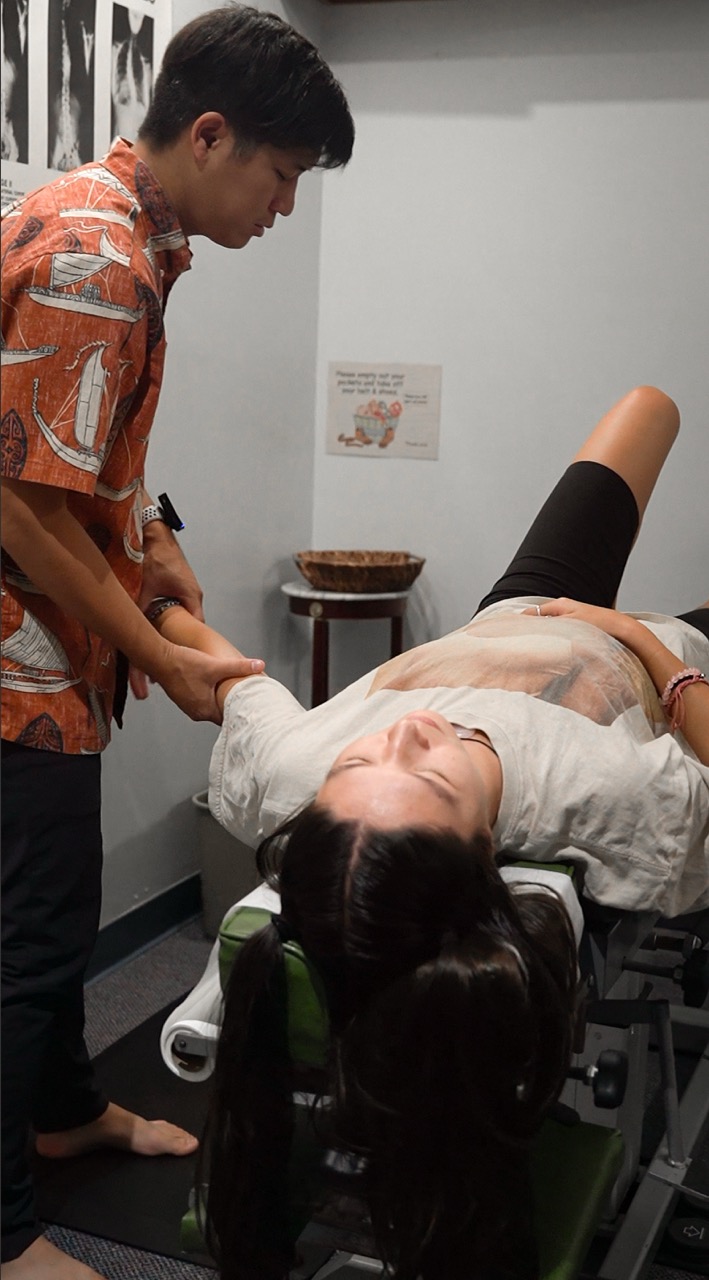
The exam covers cervical range of motion in each plane, segmental joint motion, palpation of the deep suboccipital muscles and the upper trapezius, jaw mechanics, thoracic mobility, deep neck flexor endurance, balance and eye-tracking screens, and a neurologic assessment of reflexes, strength, and sensation in the arms. Imaging is ordered or coordinated when the history or exam warrants it, and the clinic refers out when findings point beyond conservative care.
Upper Cervical Focus in a Whiplash Case
Ke'Ale Chiropractic's upper cervical emphasis is well matched to this injury. The joints between the skull, atlas, and axis carry an unusually dense supply of position-sensing receptors. When those segments are irritated and moving poorly, the brain receives conflicting information about where the head is in space. That mismatch helps explain the dizziness, visual strain, and cognitive fog that so many whiplash patients describe and that a purely muscular explanation does not cover.
Care usually combines gentle, specific adjusting or mobilization of the restricted segments, soft tissue work for the suboccipitals, scalenes, and upper trapezius, and progressive rehabilitation. Deep neck flexor training and scapular control work start early at low loads. Gaze stabilization and head repositioning drills are added when balance or visual symptoms are present. Frequency is set by how you respond, not by a fixed package.
A Realistic Recovery Timeline
Most uncomplicated whiplash cases improve substantially over six to twelve weeks with consistent care and home work. Early on, the goal is calming irritation and restoring basic motion. The middle phase rebuilds endurance in the muscles that hold the head upright, since those fatigue long before the neck feels normal. The final phase restores tolerance for the things that actually matter to you: a full commute in traffic, surfing, lifting at work, or a desk day without a headache by three in the afternoon.
Recovery is rarely a straight line. Flare-ups after a long drive or a poor night of sleep are common and are not a sign that progress has been lost. Cases involving prior neck injury, arm symptoms, high initial pain, or significant head involvement often take longer and benefit from co-management with other providers.
What Slows People Down
Three things stand out. Waiting weeks before being evaluated. Stopping care the moment pain drops, before strength and control have caught up, which leaves the neck vulnerable to the next minor strain. And returning to full screen or gym load too quickly, which reliably provokes symptoms in a neck that has not rebuilt its endurance.
Get Evaluated After Your Accident
If you were in a collision anywhere on Oahu, from a fender bender in Kakaako to a chain-reaction stop on the H-1, do not wait for symptoms to declare themselves. Ke'Ale Chiropractic in Honolulu offers focused evaluation of whiplash injuries and builds recovery plans around what the exam actually finds. Schedule a visit with Dr. Wyland Luke or Dr. Bryan Luke and get a clear picture of what your neck and head need.


